
Building Operational Capabilities as a Strategic Advantage
Research and development is for me not experimenting in isolation from reality, but consciously building operational capabilities that translate into real project value.
Development does not mean acquiring knowledge to me.
Development means building operational capabilities that I transform over time into strategic advantages.
Knowledge is a transitional state.
Operational capability is an asset.
Therefore, I do not treat learning as content consumption, but as an engineering process:
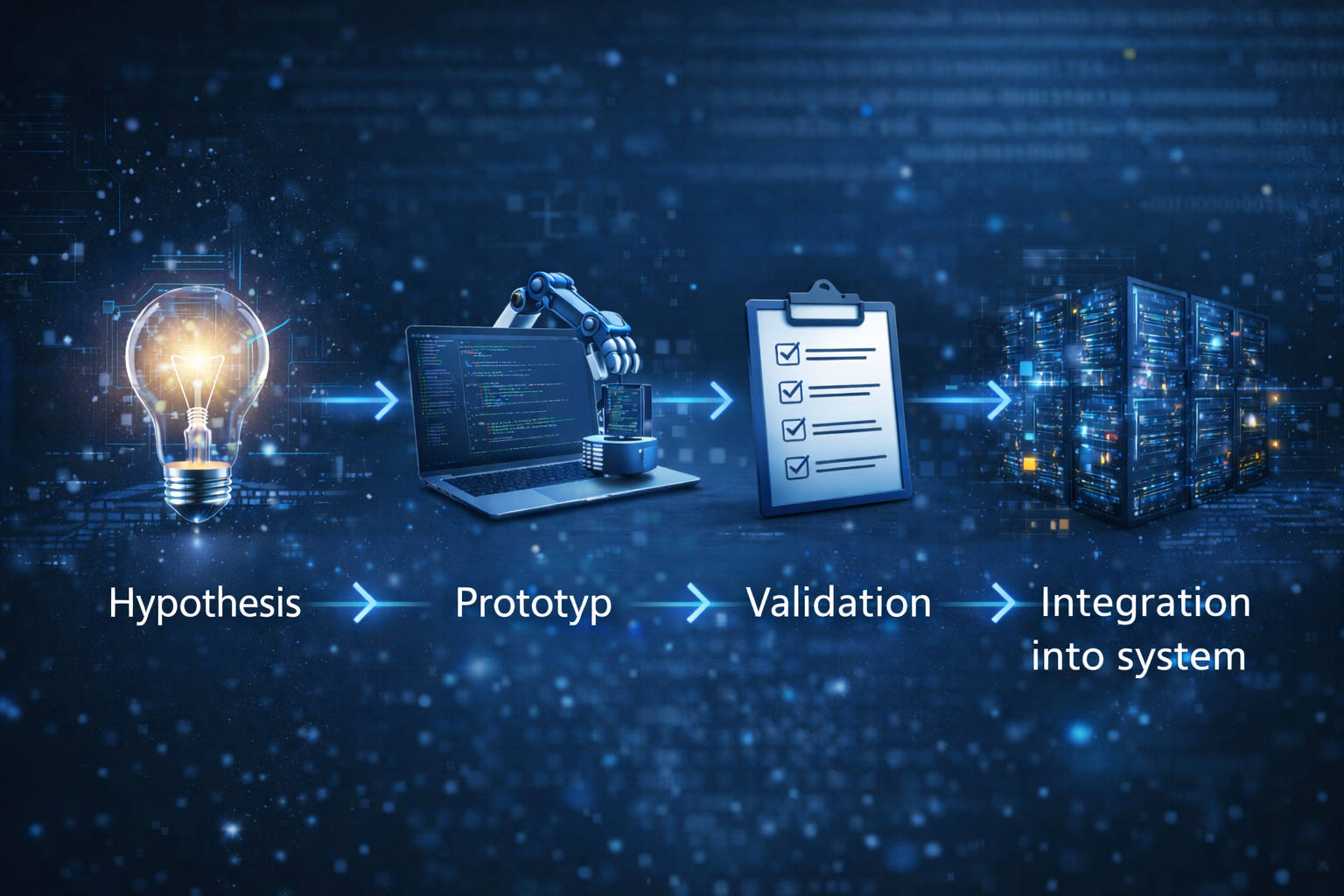
This approach applies to code, architecture, infrastructure, and the way work is organized.
Prototype as a Cognitive Tool
I do not learn through theoretical analysis. I learn through building.
Every new topic – whether automation, network architecture, high-availability systems, or data processing – I materialize in the form of a working prototype. A prototype is a cognitive tool for me.
Only when a solution works in a controlled environment can we speak of real understanding.
The difference between an experiment and real R&D lies in repeatability and condition control.
Therefore, I build environments that allow:
- isolating variables,
- simulating loads,
- testing failures,
- analyzing system behavior under conditions close to production.
Infrastructure as a Condition for Real Development
Development without infrastructure support depends on external providers.
Dependency limits the pace of experiments and increases iteration costs.
Therefore, I build my own operational environment that enables:
- parallel maintenance of test, staging, and experimental environments,
- simulating high-throughput architectures,
- testing security solutions and network segmentation,
- performance analysis under real load,
- experiments with data processing and ML models without dependencies on external APIs.
My infrastructure includes four layers:
Computational Layer
Server environment with a large number of threads and high available operational memory, allowing parallel running of multiple test environment instances, orchestration, load simulation, and work with virtualization.
Data Layer
Data storage based on solutions ensuring integrity, snapshotting, and the ability to test failure scenarios.
Backup is not an add-on – it is an element of architecture.
Network Layer
Segmented network infrastructure with own UTM/VPN enabling:
- security policy control,
- environment isolation,
- testing multi-zone architectures,
- simulating traffic and loads.
Workstation Layer
High-end workstation enabling:
- working on multiple virtual machines in parallel,
- local running of CI pipelines,
- analysis of large datasets,
- experiments using GPU.
Hardware is not the goal.
Hardware is a tool that shortens iteration time.
If an experiment takes hours instead of days, the learning pace grows exponentially.
Automation as an Accelerator
Every process performed more than twice is subject to automation.
Environment orchestration, provisioning, system configuration, process monitoring – these are not manual activities, but elements of the system.
Automation serves two functions:
- Reduces cognitive cost.
- Creates repeatability that enables scaling.
Thanks to this, an experiment ceases to be a one-time event and becomes a component of a larger architecture.
Cost and Margin Awareness
The decision to build on-premise infrastructure is not ideological.
It is economic.
I understand the cost of computing power, the cost of transfer, the cost of dependency on a provider.
I understand where technological margin is created.
Building my own resources I treat as a capital investment in operational capabilities.
Cloud is a tool.
On-premise is control.
The choice depends on the goal.
Strategic Capabilities Resulting from Infrastructure
Having a controlled R&D environment provides real advantages:
- ability to quickly deploy MVP without waiting for infrastructure decisions,
- testing high-availability architectures,
- simulating high-throughput environments,
- experiments with automation and orchestration,
- building solutions that are designed from the start with scalability in mind.
Development ceases to be abstract.
It becomes an operational process.
Crisis as a System Test
A system is worth as much as its behavior in an unpredictable situation.
Therefore, in my projects I assume:
- redundancy,
- separation of responsibilities,
- control of critical points,
- ability to recreate the environment from scratch.
R&D is not playing with novelties.
It is preparation for variability.
Long-term Perspective
I build environment and competencies in a multi-year horizon.
Not in a sprint cycle.
I understand development as a process of capability accumulation:
- technological,
- operational,
- organizational.
Every experiment, every automation, every infrastructure decision is an element of a larger whole.
It is not about knowing more.
It is about being able to do more.
Want to see this in practice? View Technologies • View My Competencies • Read my story • Go to Cooperation
